Sunday, May 31, 2015

Sell These 5 Toxic Stocks Before It's Too Late

BALTIMORE (Stockpickr) -- The big indices gave back nearly a full percentage point each on average yesterday, reminding investors that the sideways churn isn't over yet. Just when the broad market was grasping at new highs, it got swatted lower in a move much like the one back at the start of April.

>>5 Big Stocks to Trade for Gains This Summer

That prolonged sideways price action is frustrating, but it's not particularly ominous -- unless you own some toxic names in your portfolio. Frankly, the biggest gains this year haven't come from picking the right stocks; they've come from not owning the wrong ones.

Today, we're taking a closer look at five large-cap names that look toxic in May.

Just to be clear, the companies I'm talking about today aren't exactly junk. By that, I mean they're not next up in line at bankruptcy court. But that's frankly irrelevant; from a technical analysis standpoint, sellers are shoving around these toxic stocks right now. For that reason, fundamental investors need to decide how long they're willing to take the pain if they want to hold onto these firms in the weeks and months ahead. And for investors looking to buy one of these positions, it makes sense to wait for more favorable technical conditions (and a lower share price) before piling in.

>>5 Stocks Insiders Love Right Now

For the unfamiliar, technical analysis is a way for investors to quantify qualitative factors, such as investor psychology, based on a stock's price action and trends. Once the domain of cloistered trading teams on Wall Street, technicals can help top traders make consistently profitable trades and can aid fundamental investors in better planning their stock execution.

So without further ado, let's take a look at five toxic stocks you should be unloading.

PowerShares QQQ Trust
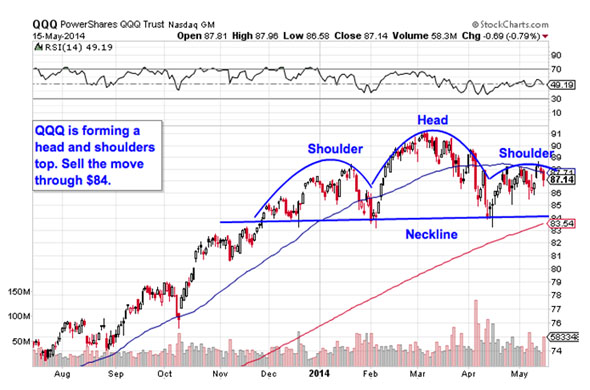

First up is "The Qs": the PowerShares QQQ Teust (QQQ), a $40 billion ETF that tracks the performance of the Nasdaq 100 Index. QQQ has been a popular trading vehicle for the last couple of years, primarily because it's tracked the Nasdaq's performance during a span where high-momentum tech names have worked really well. But since March, the opposite has been true, and this ETF has corrected to the tune of 5%.

Materially lower ground could be in the cards now, thanks to a classical bearish setup in shares. Here's what to look out for.

QQQ is currently forming a textbook head and shoulders top, a bearish reversal pattern that indicates exhaustion among buyers. The setup is formed by two swing highs that top out at approximately the same level (the shoulders), separated by a higher high (the head). The sell signal comes on a move through QQQ's neckline, which is right at $84. Put more simply, if QQQ can't catch a bid above $84, it becomes a sell.

It's important to remember that this stock's setup is conditional. It doesn't become toxic until that $84 neckline gets violated. In the meantime, this big index ETF has ample opportunities to change its course. That said, investors should at least be keeping a close eye on that $84 level in May. If shares break down though it, look out below.

Fluor
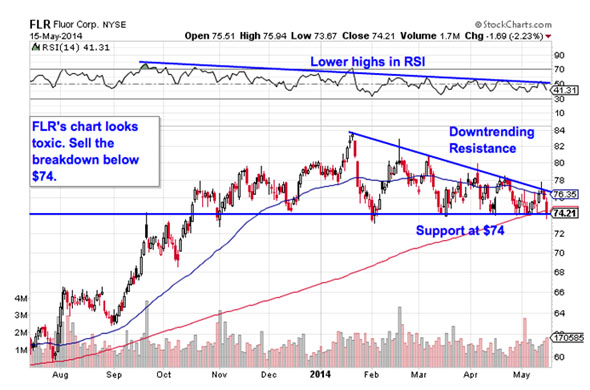

$12 billion engineering services firm Fluor (FLR) is another name that's looking toxic in May. In fact, shares have been forming a bearish price setup since all the way back in January, making it a longer-term trade with equally long-term trading implications when it triggers. That means FLR could be in store for a pretty rough summer.

Fluor is currently forming a descending triangle setup, a bearish trade that's formed by horizontal support below shares (in this case at $74), and downtrending resistance to the topside. Basically, as FLR bounces in between those two technically-significant price levels, it's getting squeezed closer and closer to a breakdown below that $74 price floor. When that happens, it's time to be a seller.

Momentum, measured by 14-day RSI, adds some extra evidence to Fluor's downside setup. Our momentum gauge has been making lower highs going all the way back to last September. Since momentum is a leading indicator of price, that doesn't bode well for FLR's longs right now.

FedEx
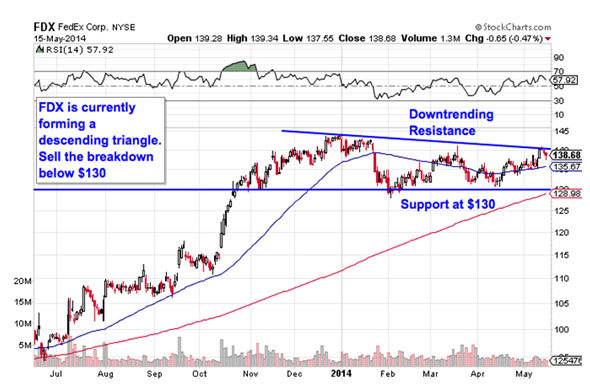
We're seeing the exact same setup in shares of FedEx (FDX). After rallying more than 38% amid strength in the transports sector, a descending triangle is indicating that FDX might be getting ready to roll over. The support level to watch is $130 – if FedEx breaks down below it, it's time to sell the shipping giant.

Why the significance at $130? Whenever you're looking at any technical price pattern, it's critical to keep buyers and sellers in mind. Patterns like head and shoulders setups and descending triangles are a good way to quickly describe what's going on in a stock, but they're not the reason it's tradable. Instead, it all comes down to supply and demand for shares.

That horizontal $130 support level in FDX is the spot where there's previously been an excess of demand for shares; in other words, it's a price where buyers have been more eager to step in and buy shares at a lower price than sellers were to sell. That's what makes a breakdown below support so significant -- the move means that sellers are finally strong enough to absorb all of the excess demand at the at price level.

For the best risk/reward tradeoff, wait for the next move lower before selling FDX.

Agilent Technologies
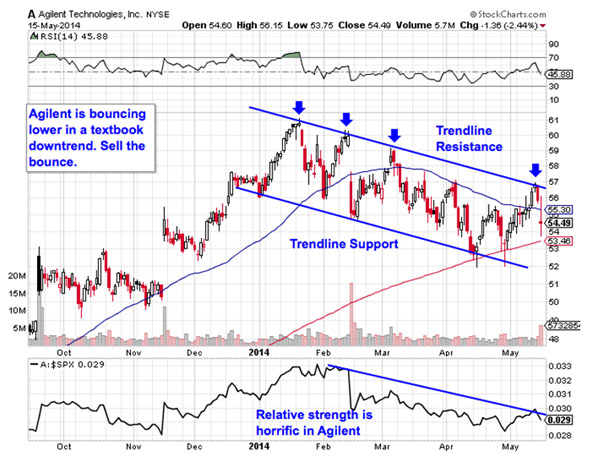
You don't have to be an expert technical trader to figure out what's going on in shares of measurement equipment manufacturer Agilent Technologies (A); this chart is about as simple as they get. Agilent is currently forming a textbook downtrending channel, and that makes this a toxic name in May.

The setup is formed by a pair of parallel trend lines: a resistance line above shares, and a support line below them. Those two lines on the chart provide traders with the high-probability range for Agilent's shares to stay within. When it comes to trend channels, up is good and down is bad; it's really as simple as that. And with shares moving lower off of trend line resistance for a fourth time since January, now's the time to sell this toxic stock.

Another indicator, relative strength (not to be confused with RSI), is the side signal that's pointing to downside in Agilent in May. Relative strength has been trending lower since February, indicating that this $18 billion stock is continually underperforming the broad market this year.

Walgreen
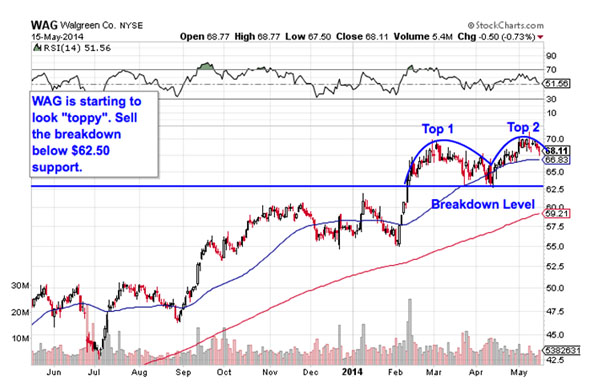
Last up is Walgreen (WAG), a name that's shown investors some outstanding performance this past year. In the trailing 12 months, Walgreen has rallied more than 39%, outperforming the S&P 500 by more than double. But after climbing higher for so long, WAG is starting to look "toppy" this month. Here's how to trade it.

Walgreen is currently forming a double top setup, a bearish reversal pattern that looks just like it sounds. The double top is formed by a pair of swing highs that max out at approximately the same price level. The sell signal comes when the trough that separates the two highs gets violated. For WAG, that breakdown level is right at $62.50, a price level that shares are moving back down toward this week.

Like the other conditional trades on this list, until the breakdown below $62.50 happens, downside isn't a high probability trade -- yet. When and if $62.50 gets taken out, though, you'll want to be a seller. If you decide to short WAG on the break, keep a protective stop at the 50-day moving average.

To see this week's trades in action, check out the Toxic Stocks portfolio on Stockpickr.

-- Written by Jonas Elmerraji in Baltimore.


RELATED LINKS:


>>3 Stocks Breaking Out on Big Volume


>>5 Rocket Stocks to Beat a Sideways Market


>>5 Tech Stocks Entering Breakout Mode

Follow Stockpickr on Twitter and become a fan on Facebook.

At the time of publication, author had no positions in stocks mentioned.

Jonas Elmerraji, CMT, is a senior market analyst at Agora Financial in Baltimore and a contributor to

TheStreet. Before that, he managed a portfolio of stocks for an investment advisory returned 15% in 2008. He has been featured in Forbes , Investor's Business Daily, and on CNBC.com. Jonas holds a degree in financial economics from UMBC and the Chartered Market Technician designation.

Follow Jonas on Twitter @JonasElmerraji


Thursday, May 28, 2015

Advisers warming to real assets as stock market volatility picks up

real assets, asset allocation, mlp, reit, real estate, hedge funds, private equity, stocks, bonds, equities

The latest bout of stock market volatility is helping to make the case again for diversifying into assets that investors can actually touch and feel.

Physical real estate, real estate investment trusts and infrastructure master limited partnerships are the most common forms of the real assets that are hitting the radar screens of savvy financial advisers.

Much like the broader alternative investments universe, real asset investments are becoming an increasingly popular for reducing portfolio volatility.

As the data illustrate, most real asset investments are more about non-correlated exposure than white-hot performance.

(Don't miss: The perfect storm: Why alts make sense)

So far this year, real estate mutual funds tracked by Morningstar Inc. gained an average of nearly 10%, while the S&P 500 has been virtually flat.

Last year, when the S&P 500 gained 30%, the category gained 2.3%.

Morningstar doesn't have a specific category for master-limited partnership funds, but a screen of funds with MLP in the name found that the average return this year was 2.8%.

The MLP fund universe had an average gain of 24.4% last year.

“The main thing about real assets is you're getting the diversification of lower correlation to traditional assets, but you're also typically getting some inflation protection,” said James Cunnane, chief investment officer of the MLP & energy Infrastructure team at Advisory Research Investment Inc.

Even with inflation in the U.S. at barely discernable levels, the Fed's unwinding of quantitative easing and the looming threat of higher interest rates make the case for real assets an increasingly logical argument.

“The longer-term attraction of real assets is definitely the inflation sensitivity, because with higher inflation, you will be better off in real assets,” said Keith Black, managing director of curriculum and exams at the Chartered Alternative Investment Analyst Association.

“Another part of the attraction is that we're talking about real assets,” he added. “After the financial crisis, people realized that the stocks and bonds they owned were just paper assets.”

As a subcategory of alternative investments, real assets are sometimes overshadowed by the higher-profile hedge funds and private equity investments, but there are components of the financial advice community that are heavily committed to real asset exposure.

An as-yet released study by Cohen & Steers Inc. estimates that 90% of advisers are alre! ady using real assets for their client portfolios.

But despite the widespread use of real assets, advisers are only using real assets in 20% of their client base, according to the report, which was based on a survey of 660 financial advisers.

For those accounts containing real assets, the allocation is typically between 5% and 9%, illustrating a serious commitment to the asset class.

“It was a little surprising to us to find that among advisers using real assets, they are only using it in about one out of five of their client portfolios,” said Vince Childers, manager of the Cohen & Steers Real Asset Fund (RAPIX).

The research also found that only 40% of advisers are treating real assets as a core holding, with the majority using the asset class for tactical purposes.

Mr. Childers acknowledged his obvious bias when suggesting that investors should have between 10% and 20% allocated to real assets.

“We think people are under-allocated to real assets,” he said, citing an ability to hold value in an inflationary environment.

“But people need to understand that the portfolio diversification benefits go beyond inflationary scenarios,” he added. “In periods like we've seen recently, when stocks and bonds are not diversifying each other very well, that's the sweet spot for real assets.”

The broadest definition of real assets can include everything from direct ownership in real estate to fine art, but the Cohen & Steers study primarily focused on real estate, REITs, infrastructure MLPs and natural resource equities.

The survey found that more than 80% of respondents recognize direct real estate ownership as a real asset, but only about 30% are using direct real estate as a real asset investment.

REITs, which are used by 75% of the respondents, stood out as the most popular means of gaining real asset exposure. Interestingly, less than 35% of the respondents recognized REITs as a real asset.

Nearly 70% of respondents recognized prec! ious meta! ls as a real asset, but less than 40% say they are using precious metals as a real asset allocation.

Looking past what might appear to be some confusion or lack of communication surround real asset nomenclature, it is more important to focus on the growing appetite for the benefits that real assets can bring to a portfolio.

“People are worried about interest rates going up,” Jerry Swank, founder of Cushing Asset Management, said while discussing a new partnership to manage MLP and energy-related mutual funds with MainStay Investments.

“Don't underestimate this humongous energy renaissance going on in the U.S.,” he added. “We have a decade or more of growth in that area ahead of us.”

Just like there are multiple stripes of hedge funds and alternative strategy mutual funds, a real asset allocation should be built around diversification.

While an MLP fund allocation can hopefully catch the energy infrastructure renaissance, the REIT space is poised to benefit from increased demand for housing and office space.

“Right now we're seeing improving fundamentals in real estate, but they're still not building enough to make up for what hasn't been built over the past five years,” said Calvin Schnure, senior economist at the National Association of Real Estate Investment Trusts.

“Things that affect real estate are different than the things that affect stocks,” he added. “Improved job growth and consumer spending will benefit REITs because that translates almost one-for-one to an increased need for office space, because job growth means vacancy rates will fill faster.”

Workers recover last Corvette from Ky. sinkhole

BOWLING GREEN, Ky. (AP) — The last of eight classic Corvettes gobbled up by a giant sinkhole in Kentucky has been recovered, but the mood was somber as the mangled car was pulled to the surface.

The 2001 Mallett Hammer Z06 Corvette was buried in dirt and rocks, dozens of feet below the surface of the National Corvette Museum in Bowling Green. The man who donated the car to the museum, Kevin Helmintoller, says the vehicle looks like a piece of tin foil.

STORY: Museum to display cars eaten by sinkhole

STORY: Watch sinkhole swallow 8 Corvettes

The prized cars were swallowed by the sinkhole that opened up in February beneath part of the museum.

Museum spokeswoman Katie Frassinelli says the damage was progressively worse as each car was pulled out.

The museum will display the cars through August. The ones deemed fixable will be shipped to Michigan for repairs.

Wednesday, May 27, 2015

What if the Data Are Wrong?

Print Friendly

We've been closely tracking Canada's export activity not only because the Bank of Canada (BoC) is currently fixated on it, but also because many of our recommendations in the resource sector are dependent upon it. 

To be sure, the BoC hopes to resuscitate Canada's ailing manufacturing industry, while the major players in the resource space are already working toward diversifying their markets, particularly as the US is in the midst of an energy renaissance thanks to the shale boom.

But Canada is a few years away from being able to ship its energy products to emerging Asia. In the meantime, the US is still Canada's largest trading partner by far, so much of the commentary regarding the BoC's expectation that exports will soon drive Canada's economy again necessarily focuses on the US economy.

Although many of the recent data regarding Canada's export activity have been mixed or even downright gloomy, this week economists with CIBC World Markets published an intriguing analysis suggesting that official data may have been understating export activity.

In the most recent issue of Canadian Edge, we unpacked Canada's international merchandise trade data for December, which showed the trade deficit widening to CAD1.7 billion from the prior month's revised deficit of CAD1.5 billion. That number fell significantly short of the consensus forecast, which had called for the deficit to narrow to CAD650 million.

Though exports were up 0.9 percent month over month, imports grew by 1.2 percent from a higher base. Energy products were the main underperformers in the export sector, with their total value declining 4.5 percent sequentially and 0.1 percent year over year.

But even with this disappointing result, energy products still accounted for nearly CAD9 billion, or about 21.5 percent, of total exports for December. Exports of crude oil and crude bitumen were singled out as the pri! mary culprit in the energy space, with exports falling 5 percent, to just under CAD6 billion, on lower volumes.

Interestingly, economists with CIBC World Markets wonder whether Statistics Canada (StatCan), the government agency that tracks and reports most of the country's economic data, may be employing a methodology that's understating Canada's oil trade. They note that the US Census Bureau, the US Energy Information Administration, and Canada's National Energy Board (NEB) all report data that show rising volumes for Canada's energy exports, with the latter agency's data showing a 12 percent rise year to date through October versus the prior-year period.

But instead of relying on US import data for its calculations, StatCan instead aggregates data from Canada's provincial energy departments. As a result, its figures tend to be lower, which meant it reported a rise in export volumes that was about 33 percent lower during the aforementioned period than the one reported by the NEB.

CIBC says that if the NEB's data are indeed correct and had been used instead when calculating export activity, it would have reduced the country's trade deficit by CAD1 billion per month during the fourth quarter. That almost merits an exclamation point, because it means that Canada would have come much closer to a trade surplus during that time. In the fourth quarter, the country's trade deficit averaged CAD1.36 billion, so shaving CAD1 billion from that number would have meant an average monthly trade deficit of just CAD360 million.

If StatCan's methodology is problematic here, then at the very least CIBC does not believe it's affecting other important data, such as the agency's calculation of gross domestic product (GDP). The economists say StatCan's production data are largely in line with those reported by the NEB.

So while Canada's export-oriented manufacturers are still struggling, it's possible that export activity in the country's energy sector has been ! substanti! ally better than what's been reported.

Monday, May 25, 2015

J.C. Penney Gets a Boost from Improved Holiday Sales

Sales pick up at JC Penney in key holiday periodJustin Sullivan/Getty Images NEW YORK -- J.C. Penney said Tuesday that a key revenue measure rose 2 percent during its November-January quarter, which includes the crucial holiday shopping season. It's the first time since early 2011 that the department store chain has recorded a quarterly sales gain. It's encouraging news for J.C. Penney (JCP), shares of which have been battered by investor pessimism that it can recover from a steep sales slump. Under former CEO Ron Johnson, who was ousted last April after 17 months on the job, J.C. Penney's sales plummeted and it recorded massive losses. The Plano, Texas-based company then brought back Mike Ullman as CEO. He is trying to attract shoppers by restoring the frequent sales events and basic merchandise ditched by Johnson in his quest to target younger, wealthier consumers. Shares have lost about 86 percent of their value since early February 2012 when enthusiasm was high over Johnson's transformation plan. In Tuesday morning trading, the stock added 12 cents, or 2.1 percent, to $5.80. "While 2013 brought a lot of change and challenges to J.C. Penney, the steady improvements in our business show that the company's turnaround is on track," said Ullman in a statement Tuesday. He noted that the sales measure, revenue at stores opened at least a year, rose in the fiscal fourth quarter despite bad weather in many parts of the U.S. During the nine-week holiday period in November and December, the sales metric rose 3.1 percent at J.C. Penney. That's important because the holiday season can account for 20 to 40 percent of a retailer's annual sales. But this winter, many retailers discounted heavily to bring in shoppers in a slow economic recovery, hurting profits. It's not clear how much the holiday sales gains at J.C. Penney came at the expense of profits. Investors will find out when the company reports its final fourth-quarter results, on Feb. 26. The company's most recent monthly sales figures have shown some improvement after a long decline. Sales at stores open at least a year edged up 0.9 percent in October, the first monthly increase since December 2011. The metric jumped 10.1 percent in November. But the company has not broken out December sales, saying in early January only that it was "pleased with its performance for the holiday period," and that the holiday season showed "continued progress in its turnaround efforts." At the time, it backed its outlook for the fourth quarter and said the sales measure and profit margins will likely improve from month to month.

Sunday, May 24, 2015

The first thing you should do in 2014

With 2013 come and gone, millions of people will resolve to make the most of their money in the coming year. Yet with the stock market moving sharply lower to begin the new year, many investors might well miss out on taking a vital step toward ensuring their long-term financial security by opening an IRA for 2014 as soon as possible.

One of the most important things you can do to start 2014 off on the right foot is to start thinking about saving for retirement. That's a tall order for many people, especially those with decades to go before they can even start dreaming of retiring. But if you want to retire rich, you have to look ahead, and having an IRA is a vital tool you can use to bring that goal closer to reality.

Why it's important to act now

Those who've followed this column know that I traditionally beat on the IRA soapbox at the beginning of most years. Last year, uncertainty about recently enacted tax rates gave some investors good reasons to wait on funding their IRA. But now that the tax-law picture has firmed up, IRAs look more attractive than ever in many ways.

In particular, the fiscal-cliff compromise that took effect at the beginning of 2013 raised tax rates on high-income taxpayers, reestablishing the 39.6% tax bracket and adding new taxes of 3.8% on investment income and 0.9% on wage income above certain high-income thresholds. Even preferential rates on capital gains rose from 15% to 20% for top-bracket taxpayers. As a result, the tax deferral benefits from IRAs are more valuable than ever for many.

Now it's true that you have plenty of time to make an IRA contribution for 2014. Indeed, you can still make a contribution to an IRA for 2013 until April 15. But the bull market of the past five years has emphasized just how important it is to put time on your side by getting money into an IRA sooner rather than later. At the same time, IRAs also make it easier for you to manage your risk than taxable accounts.

The value of high-growth stocks in IRAs

Investing in high-growth stocks within an IRA highlights the full potential that tax-deferred retirement accounts provide. For instance, Max Levchin, a well-known entrepreneur in the technology industry who was the co-founder of eBay's PayPal division, demonstrated the value of a Roth IRA a couple years ago when the social-network company Yelp came public. SEC filings showed that Levchin's Roth IRA owned more than 13.25 million shares of Yelp, and based on valuations at the time, the Roth IRA likely earned a gain of about $100 million when Yelp went public. Since then, Yelp has tripled in price, meaning potentially greater gains for any shares that Levchin has kept in his Roth.

Yet the other side of the coin gives another advantage of IRAs: You can sell your shares of high-flying growth stocks at any time without tax consequences. That can help IRA investors avoid traps that others traditionally fall into after long bull markets.

For instance, during the 1990s tech boom, millions of investors rode tech stocks to riches. Yet for those who held those stocks in taxable accounts, the prospect of losing a huge chunk of their capital gains to taxes led many to avoid selling shares. As a result, many investors ended up riding tech stocks all the way back down, never reaping any profit from the boom at all. By contrast, investors in an IRA were free to sell whenever they decided the tech boom was over, with no immediate tax consequences.

Some investors see similar signs of overpricing in today's market. In particular, tech and social-media stocks have become a target of those arguing that a new bubble has formed. In particular, Twitter (ticker: TWTR) has enjoyed phenomenal gains in the couple of months since it went public, more than doubling from its IPO price and climbing substantially higher from where it traded on its first day as a public company. Similarly, Facebook (FB) and LinkedIn (LNKD ) have produced stellar growth in boosting advertising revenue, especially with Facebook having ! demonstra! ted its success in the mobile ad space. Yet with these stocks carrying pricey valuations that reflect investors' high expectations for their future, anything short of perfection going forward could cause dramatic corrections -- corrections that those investing in taxable accounts will fear protecting themselves from because of the tax liability involved.

Don't wait

Obviously, if you don't yet have an IRA with winning stocks in it, then you can't take full advantage of every opportunity that IRAs give you. But the sooner you establish an IRA, the sooner you'll be able to consider all of these winning strategies while leaving yourself able to take action if downturns change your investing mindset.

The Motley Fool is a USA TODAY content partner offering financial news, analysis and commentary designed to help people take control of their financial lives. Its content is produced independently of USA TODAY.

<SCRIPT language='JavaScript1.1'SRC="http://ad.doubleclick.net/adj/N4538.USAToday/B2304017.8;abr=!ie;sz=550x300;ord=[timestamp]?"></SCRIPT><NOSCRIPT><AHREF="http://ad.doubleclick.net/jump/N4538.USAToday/B2304017.8;abr=!ie4;abr=!ie5;sz=550x300;ord=[timestamp]?"><IMGSRC="http://ad.doubleclick.net/ad/N4538.USAToday/B2304017.8;abr=!ie4;abr=!ie5;sz=550x300;ord=[timestamp]?" BORDER=0 WIDTH=550 HEIGHT=300ALT="Advertisement"></A></NOSCRIPT>

Wednesday, May 20, 2015

Is The Best Buy Stock Run Over?

The shares of Best Buy Co. Inc. (NYSE: BBY) are up almost 250% this year. The company’s management has staged a turnaround, at least partially. But the progress is not great enough for Best Buy to have its current market capitalization of $14 billion. After all, its earnings from continuing operations last quarter were only $44 million. Even if that number soars, it likely will not be enough to justify the $14 billion valuation.

The theory behind the increased value of Best Buy is that its revenue is no longer shrinking, and it may recover this holiday season. In its most recently reported quarter, Best Buy had revenue of $9.4 billion, about flat with last year’s same quarter. Same-store sales for the period rose only 0.3%. The number only looks good because in the year-ago quarter same-store sales were off 5.1%.

Part of the enthusiasm about Best Buy is the strategic plan of new CEO Hubert Joly: drop prices below the competition and offer better in-store services. The problem with the first part of the program is that the move is likely to lower margins. The problem with the second is that consumers are used to shopping for consumer electronics at Amazon.com Inc. (NASDAQ: AMZN), where there is no service. The lack of service at Amazon is replaced by the convenience of shopping from home and the ability to browse a seemingly infinite number of consumer electronics products across a nearly limitless number of prices. A physical store has no means to match that.

So, the new wisdom about the high valuation of Best Buy is that it has beaten, or at least matched, Amazon in the prices and service aspects of consumer electronic sales. Yet, there is scant evidence of that. It will not be until holiday sales numbers are turned in by the two companies that Best Buy can be considered a winner, even on the most modest level. And “modest” is the problem. Even a small improvement in Best Buy’s revenue says nothing other than Amazon is not trampling it with quite the same force as a year or two ago. That does not mean the beating ever entirely ended.

Best Buy’s turnaround is nothing more than marching in place, which is not enough to cement a better future.

Holiday shopping spree not for everyone

NEW YORK (AP) — Many Americans are watching the annual holiday spending ritual from the sidelines this year.

Money is still tight for some. Others are fed up with commercialism of the holidays. Still others are waiting for bigger bargains.

And people like Lark-Marie Anton Menchini are more thoughtful about their purchases. The New York public relations executive says in the past she'd buy her children up to eight Christmas gifts each, but this year they're getting three apiece. The leftover money is going toward their college savings.

"We told them Santa is ... being very conscious of how many gifts he puts on his sleigh," Menchini, 36, says.

Despite an improving economy, most workers are not seeing meaningful wage increases. And some of those who can splurge say the brash commercialism around the holidays — many more stores are opening for business on Thanksgiving — is a turnoff.

But perhaps the biggest factor is that shoppers are less motivated than ever by holiday sales. Since the Great Recession, retailers have been dangling more discounts throughout the year, so Americans have learned to hold out for even deeper holiday savings on clothes, electronics and more. To stay competitive and boost sales, retailers are slashing prices further during their busiest season of the year, which is cutting into their own profit margins.

There aren't reliable figures on how many people plan to shop during the holidays. But early data points to a shift in holiday spending.

The National Retail Federation estimates that sales during the start to the official start to season — the four-day weekend that began on Thanksgiving Day — dropped 2.9% from last year to $57.4 billion. That would mark the first decline in the seven years the trade group has tracked spending.

And during the week afterward — which ended on Sunday — sales fell another 2.9% compared with a year ago, according to data tracker ShopperTrak, which did not give dollar amounts. Meanwhile, the nu! mber of shoppers in stores plunged nearly 22%.

The numbers are sobering for retailers, which depend on making up to 40% of their revenue in the last two months of the year. They suggest shifts in the attitudes of U.S. shoppers that could force stores to reshape their strategies:

SHOPPERS WANT DEALS

Stores slashed prices during the recession to get financially-strapped shoppers in stores and to better compete with the cheaper prices of online retailers like Amazon. But shoppers got used to those deals and now won't buy without them. The constant discounting has blunted the "wow" factor of sales during the holidays.

For instance, some retailers were offering discounts of 40% or more on the day after Thanksgiving known as Black Friday. But Jennifer Ambrosh, 40 was unimpressed with the "deals" she saw on that day. "There's a lot of hype, but ... the deals aren't that good," Ambrosh, an accountant, says.

Overall, the retail federation expects spending in November and December to rise 3.9% to $602.1 billion. But to get that growth, analysts say retailers will need to discount heavily, which eats away profits.

There are signs that profits for the quarter that includes the holiday season are being hurt by the discounting. Wal-Mart and American Eagle Outfitters are among 47 retailers that have slashed their outlooks for either the quarter or the year.

Overall, retailers' earnings growth is expected to be up 2.1%, according to research firm Retail Metrics. That would be the worst performance since profit fell 6.7% in the second quarter of 2009 when the country was in a recession.

SCRUTINIZING PURCHASES

The recession not only taught Americans to expect bargains. It also showed them that they could make do with less. And in the economic recovery, many have maintained that frugality.

So whereas in a better economy, Americans would make both big and small purchases, in this economy they're being more thoughtful and making choices about what to buy.

Ana! lysts say! that hasn't boded well for retailers that sell clothing, shoes and holiday items. That's because Americans are buying more big-ticket items over the holidays.

Government figures show that retail sales were up 0.7% in November, the biggest gain in five months. But the increase was led by autos, appliances and electronics.

Auto sales jumped 1.8%, furniture purchases rose 1.2% and sales at electronics and appliances stores rose 1.1%. Meanwhile, sales at department stores and clothing chains were weak.

Americans are leaning toward big purchases for two reasons. They want to take advantage of low interest rates. And since many paid down debt since the recession, they feel more comfortable using credit cards again for such purchases.

But they won't do that and buy smaller items. "This is still a weak, fragile shopper," says Craig Johnson, president of Customer Growth Partners, a retail consultancy.

Retailers including Macy's and Target in recent months have said that shoppers' focus on big-ticket items has put a damper on sales of discretionary items, and the retail federation says it has hurt holiday sales in particular.

HOLIDAY CONSUMERISM

Black Friday used to be the official kickoff to the buying season, but more than a dozen chains opened on Thanksgiving this year.

That didn't sit well with some shoppers who viewed it as an encroachment on family time. Some threatened to boycott stores that opened on the holiday, while others decided to forgo shopping altogether.

In a poll of 6,200 shoppers conducted for the retail federation prior to the start of the season, 38% didn't plan to shop during the Thanksgiving weekend, up from 34.8% the year before.

Ruth Kleinman, 30, isn't planning to shop the entire season in part because she's disheartened by the holiday openings. The New Yorker says the holiday season "has really disintegrated."

While some shoppers didn't approve, analysts say stores will need to open on the holiday to appeal to the masses! . Overall! sales declined over the holiday weekend, but several retailers said there were big crowds on Thanksgiving. "Customers clearly showed that they wanted to be out shopping," says Amy von Walter, a Best Buy spokeswoman.

Analysts say stores will need to redefine Thanksgiving as a family tradition beyond sitting at the table eating turkey to make more shoppers comfortable.

"They have to show that they're maintaining a family tradition in new ways," says Marshal Cohen, chief retail analyst at market research firm NPD Group.

AP Business Writer Mae Anderson in New York contributed to this report.

Tuesday, May 19, 2015

Record-Low H.K. Home Sales Spur Realtor Loss: Chart of the Day

The tumble in Hong Kong's home sales to a record low signals further declines in Midland (1200) Holdings Ltd., the city's largest listed realtor, according to Bocom International Holdings Co.

The CHART OF THE DAY shows the three-month average of residential transactions in Hong Kong fell to 3,693 units in September, the lowest since at least 1996, according to government data compiled by Bloomberg. Sales have plunged even as Centaline Property Agency Ltd.'s housing-price gauge holds within 3.1 percent of a record high. The lower panel shows Midland had 9,576 employees at the end of June, according to the latest company statement, the most ever and triple the amount a decade ago, alongside the company's stock price.

Shares of Midland, which arranges about 30 percent of all property sales in Hong Kong, slid 67 percent since April 2010. The company had a net loss of HK$95 million ($12 million) in the six months to June 30, the biggest since the second half of 2008, as operating expenses exceeded sales. The stock will continue to be under pressure unless the property market recovers, said Alfred Lau, an analyst at Bocom in Hong Kong.

"This year will likely be loss-making for the company and that would eat into cash flow and the company's ability to pay dividends," said Lau, who has a sell rating on the stock and a 12-month target price that's 14 percent below yesterday's close.

Residential sales have declined as government taxes and the prospect of rising interest rates deter buyers in the world's most expensive property market. The number of real estate agents in Hong Kong surged 68 percent to 36,225 in September from January 2008 as home prices doubled, according to government data. The number of Midland employees in the city has fallen by "double digits" this year through September, Deputy Chairman Angela Wong said by phone.

Midland's managers "have to cut jobs and they have to cut shops," said Nicole Wong, a property analyst at CLSA! Asia-Pacific Markets in Hong Kong. "There is no other way out." Brokerages from UBS AG to Bank of America Corp. and Jefferies Group LLC predicted this month the city's home values will fall at least 20 percent through next year.

Wednesday, May 13, 2015

Tibergien calls for lower temperatures in “fee-only” debate

fee-only, cfp, cfp board, commissions, mark tibergien, pershing

The debate over what constitutes a "fee-only" adviser has reached fever pitch and risks spinning out of control, according to one industry executive.

“Everybody just has to step back and lower the temperature,” Mark Tibergien, chief executive of Pershing Advisor Solutions LLC, said at an InvestmentNews adviser workshop in Chicago. “Professionals don't like to be scolded or called out as a sinner.”

Last week the CFP Board replaced the listing “fee-only” with “none provided” in the compensation method of CFP profiles on its website and asked advisers to review the board's definition of "fee-only" before restoring that aspect of their profile. The CFP Board has been mired in controversy regarding misrepresentation of how some CFPs generate revenue.

The approach the CFP Board of Standards has taken in the debate has moved the discussion away from the central issue of clients' knowing how their adviser is paid and could lead to some oddball conclusions about what constitutes a conflict, Mr. Tibergien said.

“It seems to me that people have been dinged because of being affiliated with a firm, as opposed to the reality of their business,” he said. “The real issue is whether there is fee transparency and whether advisers are free of conflict.”

By being "evangelical about the issue," the CFP Board could turn the debate in a strange direction,” he added.

For instance, an adviser managing a large foundation who is paid a fee based on assets under management could be in conflict with the foundation's overall mission of giving away money to charities, which would reduce the amount of assets being managed, Mr. Tibergien said. That would not be a productive direction for the industry to go.

James Twining, founder of Financial Plan Inc. and a CFP professional, said his firm's “fee-only” designation was called into question because it has an insurance agency affiliate. The firm's compliance attorney told him that the firm is "fee-only" and Mr. Twining said he will seek to approach the issue by donating any commissions it gets from that affiliate to charity.

He has attempted to send his clients to other insurance companies when they need long-term-care or life insurance, but hasn't been able to find one that he trusts to make good decisions for his clients.

Tuesday, May 12, 2015

Susquehanna Upgrades Broadcom; Raises PT (BRCM)

Susquehanna reported on Tuesday that it has raised its rating on Broadcom Corporation (BRCM).

The firm has upgraded BRCM from “Neutral” to “Positive,” and has lifted the company’s price target from $33 to $35. This price target suggests a 23% upside from the stock’s current price of $26.91.

Analyst Chris Caso commented: “Our downgrade of BRCM in May was predicated on already high Street expectations on handsets and no notable improvement in networking to drive upside. We think expectations and the stock price have now been sufficiently reset ahead of what we expect to be catalysts in 2014 – including the iPhone 6 product cycle, potential improvement in networking and the impact from the recent Renesas acquisition. In addition, after several years of overspending on their handset initiatives, we think we are now closer to the point where the company either captures a return on that investment or is forced to moderate spending – either of which benefit profitability. We see the upcoming December analyst meeting as a potential intermediate catalyst.”

Broadcom shares were up 38 cents, or 1.41%, during pre-market trading Tuesday. The stock is down 19% YTD.

Sunday, May 10, 2015

IRS Agent Faked Pastor's Letter To Claim Charity Deduction

Here's one for the "What was that Internal Revenue Service agent thinking?" book.

At the explicit direction of Congress, since 2007 the rules for deducting cash contributions to charity have been extra strict—you even need a receipt to deduct that $20 bill put in your church's Sunday offering plate.  Giving fake documents and fibbing to the IRS to support a deduction has, of course, been a no-no for a lot longer.  Yet when IRS Revenue Agent Margaret Payne had her own 2008 and 2009 tax returns examined, she faked receipts to back up her claimed cash donations, U.S. Tax Court Chief Special Trial Judge Peter J. Panuthos concluded in a decision he issued this week.

Reached this morning at her desk at the IRS in Manhattan, Payne called the decision "completely unfair and biased,'' but declined further comment. The IRS declined any comment on the case on privacy grounds. The decision can't be appealed under a special Tax Court procedure for small cases in which taxpayers are allowed to represent themselves, as Payne did.

Here, as told in Judge Panuthos' 12-page-decision, is the sorry story: During the audit, Payne, then a 28 year IRS veteran, gave an IRS examiner copies of two year-end letters, purportedly signed by Pastor Lemuel M. Mobley of the Living Stone Baptist Church in Brooklyn, stating she had donated $6,047 to LSBC in 2008 and $14,000 in 2009.  But when the examiner met with Mobley, he said he didn't even know Payne (his congregation had only 50 to 75 members) and that the letters were a "cut and paste job" on church letterhead, with his name forged and even misspelled.

Later, after talking to a long-time congregation member who was an IRS secretary and Payne friend, as well as to Payne herself, Mobley changed part of his story.  In a letter to the IRS, he claimed that he knew Payne by a different name and that she had given the money to the church. Yet in that same letter he repeated his assertion that the letters Payne had originally given the examiner were forged, writing:   "She pieced together a financial statement and stated to me that she had one of her children to sign my name…..She stated that she was sorry for what she had done. She asked for forgiveness and I forgave her for what she had done to me as well as to the church. I did not give her or anyone else permission to sign my name on any document.''

Judge Panuthos wasn't nearly so forgiving of a woman he pointed out had graduated from college with majors in accounting and finance, completed some graduate work in forensic accounting and had been a Revenue Agent (in other words, an IRS examiner or auditor) for 20 years. In a scathing opinion upholding $6,500 in back taxes and $1300 in penalties against Payne, he described the case as full of "inconsistencies, contradicting testimony, fabricated documents, and simple untruths," and observed that the three witnesses (Payne, Mobley and  the IRS secretary) had each "not only contradicted the testimony of the others but also contradicted his or her own testimony and documents. ''

Panuthos concluded Payne had engaged in a "misguided and inept attempt to support claimed charitable contribution deductions through a fictional account of the past," and that the IRS secretary was probably in on the scheme too. He wrote: "It appears highly probable that petitioner (Payne), in concert with her longtime friend and fellow IRS employee, cut and pasted stationery from LSBC and provided the same to the IRS agent examining the returns in an attempt to support the claimed deductions."

The Judge also made fast work of any suggestion Payne had probable cause for avoiding the 20% penalty for negligence or disregard of rules, saying he was satisfied her underpayment resulted from a "very deliberate and knowing attempt to reduce her tax liabilities."